

Using AI to power real-world learning in physiology
Faculty integrate AI into case-based learning to help students practice clinical reasoning, evaluate evidence and apply physiology in real-world scenarios, preparing them for modern science and medicine.
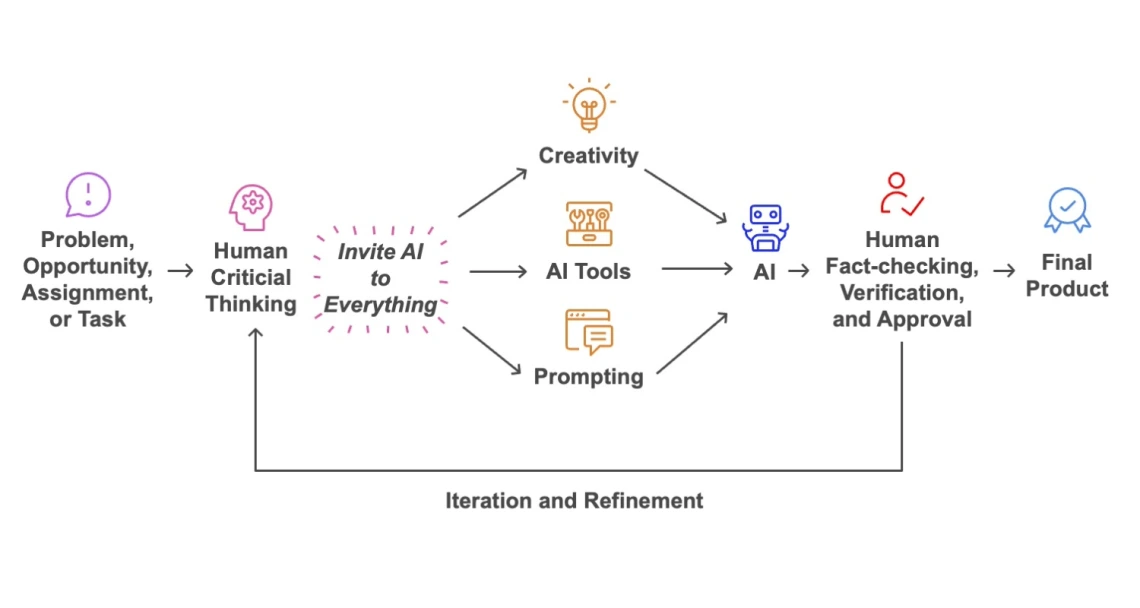
An AI-augmented problem-solving framework that illustrates the process of inviting AI ino the education space.
Randi B. Weinstein, PhD
Experiential education is a core principle of the University of Arizona Department of Physiology. Throughout the undergraduate curriculum, students are expected not only to understand physiological concepts but to apply them through problem-solving, analysis, collaboration and decision-making that reflect how physiology is used in research and clinical settings. As scientific and health care practices evolve, faculty are using artificial intelligence to expand opportunities for students to work through complex, realistic scenarios at scale.
AI is not treated as a novelty or a shortcut. Instead, instructors integrate it deliberately to support applied learning, strengthen clinical reasoning and require students to evaluate information critically. Together, these approaches reflect the department’s ongoing effort to prepare students for the demands of modern science and medicine.
AI as a platform for applied learning
In PSIO 469: Human Reproductive Physiology, Randi B. Weinstein, PhD, piloted interactive case studies supported by AI to strengthen diagnostic reasoning. Students work with simulated patients and clinical team members in multistage scenarios that evolve based on their decisions. They develop differential diagnoses, conduct interviews, select diagnostic tests and interpret findings, emphasizing application and judgment rather than recall.
Transparency is a core expectation of these assignments. Students document how AI tools are used and clearly distinguish their own reasoning from AI-generated input. This approach supports ethical use while keeping students responsible for clinical logic and decision-making.
Dr. Weinstein expanded this model in PSIO 467: Endocrine Physiology, co-taught with Dawn Coletta, PhD, by embedding a required, scaffolded series of AI-supported case studies throughout the semester. As students progress through increasingly complex endocrine cases, they practice narrowing differential diagnoses, selecting appropriate diagnostic strategies and evaluating the reliability of information sources.
Key concepts from the case studies are also assessed on in-class exams, ensuring that applied learning is fully integrated into course expectations.
Designing AI for learning, not shortcuts
The groundwork for these instructional approaches was established in PSIO 495T: Topics in Physiology: AI in Physiology and Medicine, co-taught by Dr. Weinstein and John Kanady, PhD. Dr. Kanady initially introduced the use of custom GPT-based simulated patients and later suggested structuring assignments in D2L/Brightspace using progressive disclosure. Information is released in stages to mirror clinical encounters and support deliberate reasoning.
PSIO 495T frames AI as a support for ethical and clinically relevant problem-solving. Students examine how large language models generate responses, identify appropriate uses and recognize their limitations. The course emphasizes that while AI can assist with analysis and reflection, it does not replace disciplinary knowledge or professional judgment.
One student noted, "I now understand that AI can be used for the research and reasoning aspect of healthcare. It's also a great way to check your understanding or approach to something."
A department-wide commitment
These courses reflect a broader departmental commitment to experiential education. Across the Department of Physiology, faculty design learning environments that emphasize applying physiology in ways that mirror academic, research and clinical practice. AI has become a valuable tool for expanding these applied experiences, particularly in large enrollment courses where individualized, case-based learning was once difficult to scale.
“Advances in AI are fundamentally changing how we achieve our goal of preparing students for success after graduation,” said Mingyu Liang, MB, PhD, chair of the Department of Physiology. “As AI increasingly automates content generation and routine analysis, I encourage our faculty to consider how they can be more effective in the presence of AI.”
By prioritizing experiential education rather than efficiency alone, the department helps students build transferable skills including critical thinking, ethical judgment and adaptability. The result is an undergraduate experience grounded in active learning and aligned with the evolving demands of science and medicine.